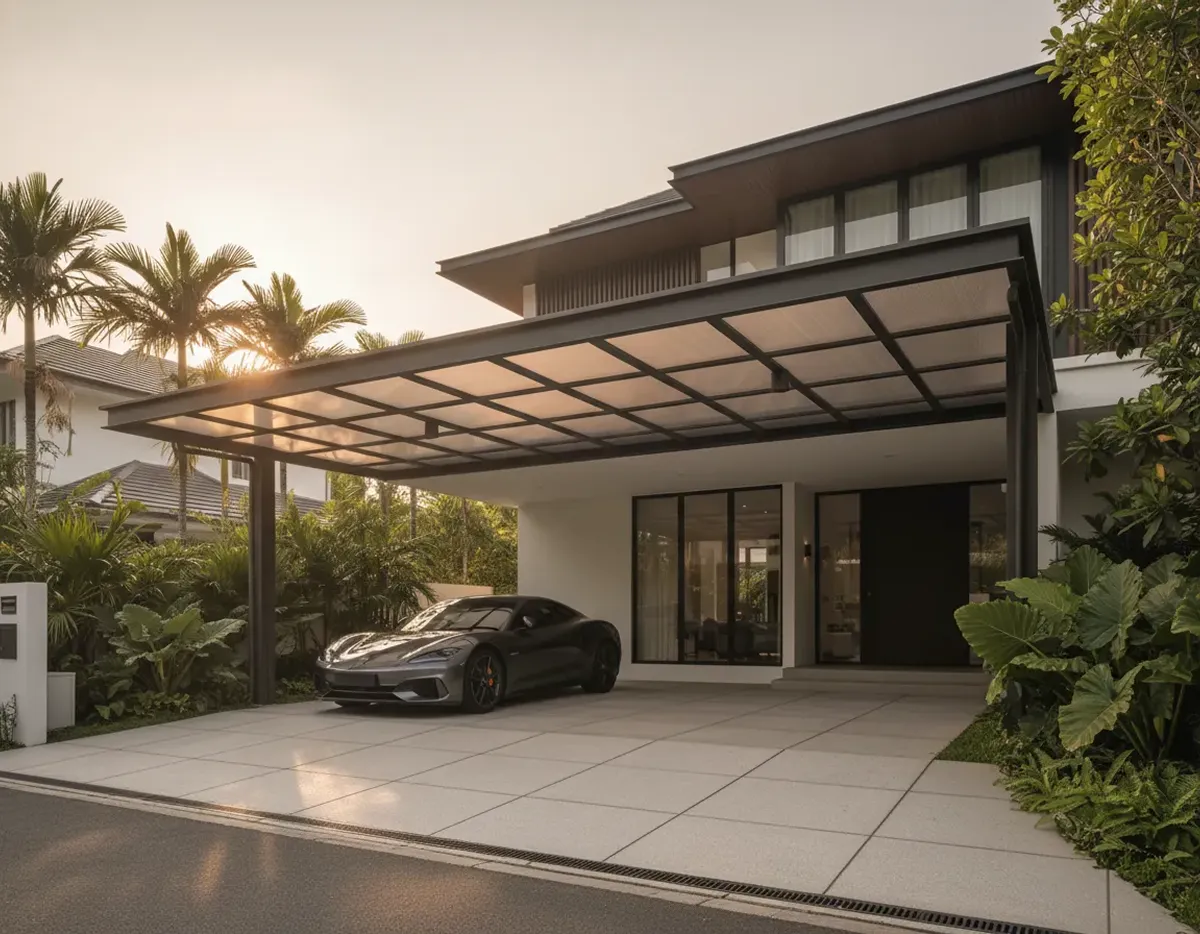
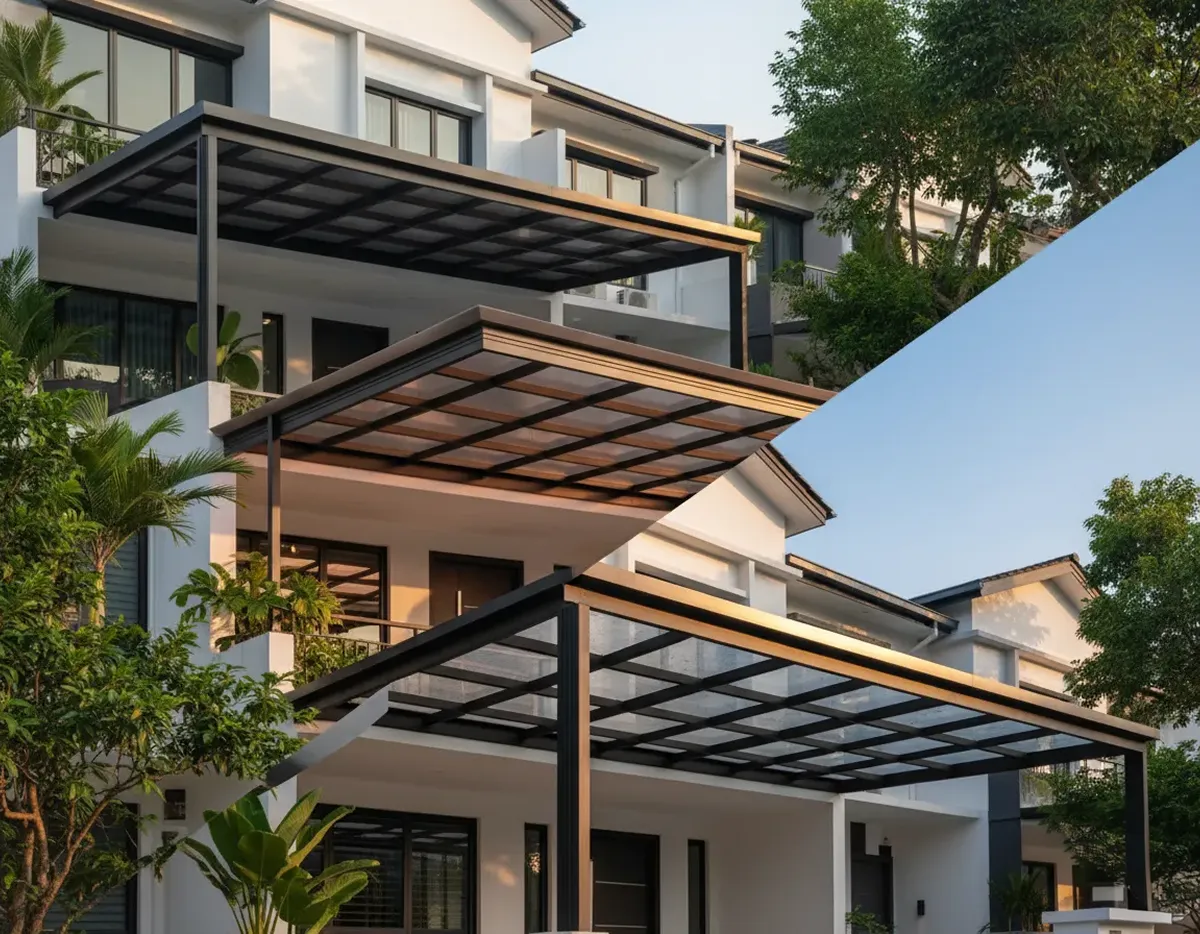
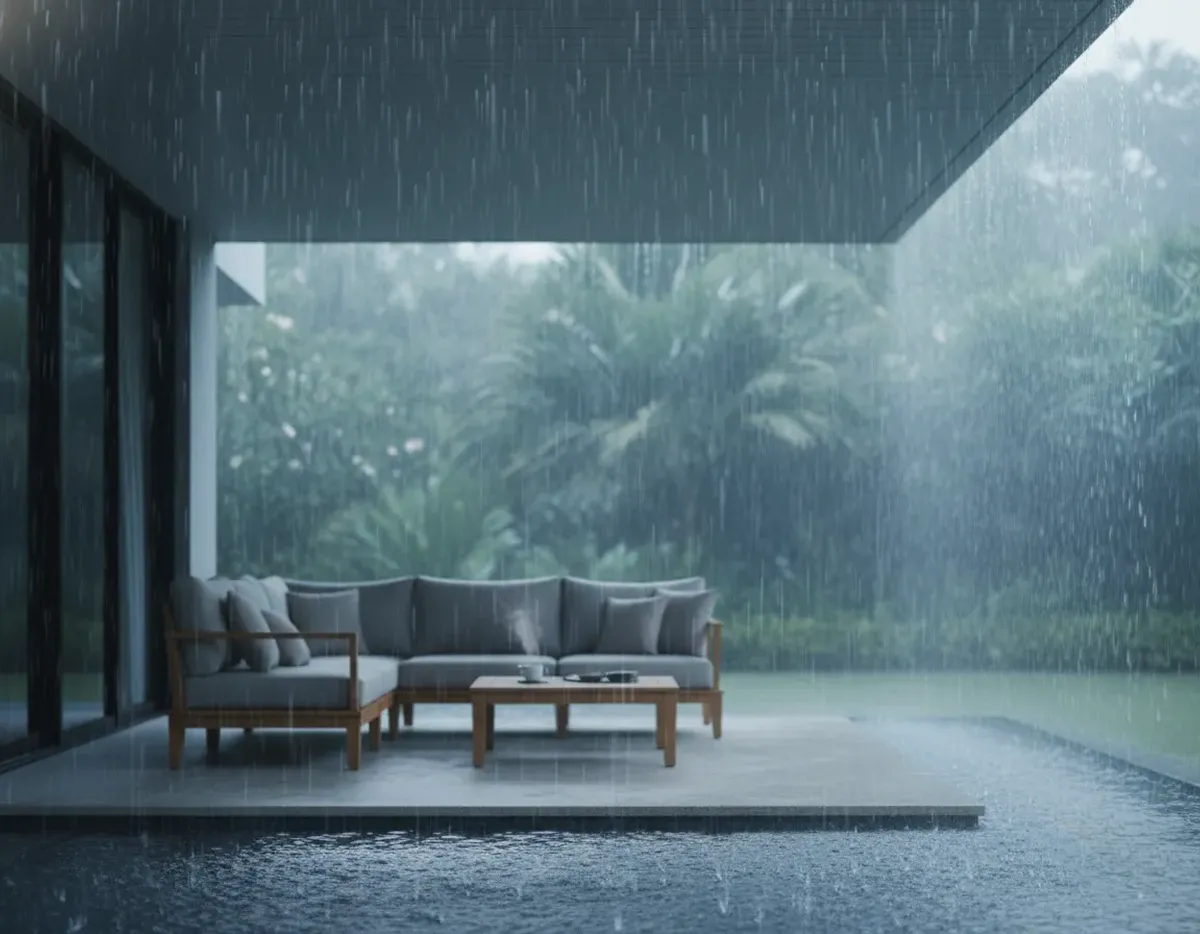
For landed homeowners in Singapore, optimizing a patio, courtyard, or roof terrace is a persistent architectural challenge. Leaving these spaces entirely open to the elements means sacrificing premium square footage to sudden tropical downpours and intense UV exposure. Conversely, installing a permanent, fixed roof can create a dark, stifling "greenhouse effect" that traps rising heat.
Motorized retractable roofs offer an engineered middle ground, transforming highly vulnerable outdoor footprints into all-weather, versatile extensions of the home.
Below is a detailed technical analysis of 5 real-world retractable roof configurations deployed across diverse landed estates in Singapore, detailing the mechanical actions, material science, and climate-specific solutions utilized.
1. The Bioclimatic Louvre System (Bukit Timah)
- Property Type: 3-Storey Semi-Detached House
- Application: Double-Volume Open-Air Dining Patio
- The Climate Challenge: The property featured an outdoor dry kitchen and dining zone that suffered from trapped radiant heat during midday and severe lateral rain penetration during monsoon seasons.
The Technical Execution
An automated bioclimatic louvre framework constructed from heavy-duty 6063-T5 structural aluminum was anchored directly into the building's reinforced concrete (RC) beams. The roof features aerodynamic aluminum blades capable of rotating precisely from $0^\circ$ to $155^\circ$.
- Thermal Management: By tilting the blades to $45^\circ$ during peak afternoon hours, the system blocks direct solar infrared radiation while leveraging natural convection—allowing rising hot air to escape vertically.
- Water Management: The louvres feature interlocking profiles lined with high-grade EPDM gaskets. When closed, the system achieves a watertight seal. Rainwater is directed into deep internal perimeter gutters integrated into the support frame, down through concealed downpipes within the structural posts, and discharged safely into the estate's ground-level drainage.
2. High-Tensile Marine Pergola (Sentosa Cove)
- Property Type: Detached Oceanfront Bungalow
- Application: Sea-Facing Entertainment Deck
- The Climate Challenge: Constant exposure to high-salinity marine air and extreme wind uplift forces during coastal squalls, which rule out standard, lightweight folding awnings.
The Technical Execution
A wall-mounted, heavy-duty retractable pergola utilizing a pre-tensioned, multi-layer PVC architectural membrane was deployed. The fabric is UV-stabilized, flame-retardant, and engineered to withstand continuous exposure without degrading.
- Anti-Corrosion Specification: To prevent galvanic corrosion caused by salt spray, all structural brackets, tracks, and fasteners were specified in Grade 316 Marine-Grade Stainless Steel.
- Smart Automation: The system is powered by an IP67-rated high-torque tubular motor integrated with an automated anemometer (wind sensor). If wind speeds cross a critical $45\text{ km/h}$ threshold, the sensor overrides manual control and automatically retracts the fabric into a protective aluminum cassette, preventing wind-drag damage.
3. The Sliding Skyglass Enclosure (Cashew Crescent)
- Property Type: Inter-Terrace House
- Application: Central Courtyard Airwell Sealing
- The Climate Challenge: An internal airwell designed for natural light was letting in torrential rain, causing elevated internal humidity and risking water damage to the home’s interior structural timber flooring.
The Technical Execution
A custom, bi-parting motorized sliding glass roof was engineered to seal the top horizontal envelope of the airwell. The installation utilizes high-performance, $12.76\text{mm}$ laminated Low-Emissivity (Low-E) double-glazed glass panels.
- Mechanical Precision: The panels glide smoothly along high-tensile aluminum tracks via a heavy-duty rack-and-pinion drive system. Dual synchronized motors ensure perfectly balanced movement to prevent track misalignment.
- Optical Efficiency: The Low-E glass layer reflects up to 70% of solar heat energy while preserving maximum visible light transmission, ensuring the interior core of the terrace remains bright but thermally comfortable.
4. Cantilevered Trellis with Integrated Vertical Protection (Serangoon Gardens)
- Property Type: Corner Terrace House
- Application: Wide-Span Side Deck
- The Climate Challenge: The patio faced a severe western sun exposure ("west sun" glare) from 3:00 PM onwards, alongside heavy lateral rain ingress due to the property's open corner orientation.
The Technical Execution
A freestanding aluminum louvre trellis covering a 6-meter span was paired with fully integrated, motorized vertical side shielding systems to create a true all-weather room.
 [Motorized Louvre Roof] ──> Manages Vertical Sun & Downpours
           │
           ▼
 [Vertical Side Screens] ──> Uses Phifer Sheerweave® + Zip-Guide Track
           │
           ▼
 Stops Lateral Rain & Glare (Prevents Track Jamming & Fraying)
- Advanced Fabric Shielding: The vertical screens utilize Phifer Sheerweave fabric—a vinyl-coated fiberglass mesh designed to maximize solar heat rejection while maintaining external visibility.
- Mechanical Reliability: The vertical blinds utilize a specialized zip-guide track system that keeps the fabric under constant lateral tension. This precise engineering configuration secures the edges completely, keeping driving rain out while preventing fabric fraying, track jamming, and wind rattling during sudden squalls.
5. Stacking Cabriolet Louvre Canopy (Katong / East Coast)
- Property Type: 3-Storey Landed Home with Attic Terrace
- Application: Top-Floor Roof Terrace
- The Climate Challenge: The homeowner required a solution that could clear the overhead view completely for stargazing, while navigating strict Urban Redevelopment Authority (URA) guidelines regarding permanent covered areas and Gross Floor Area (GFA) limitations.
The Technical Execution
A premium retractable stacking louvre system (Cabriolet action) was installed. Unlike traditional bioclimatic systems where the blades only tilt in fixed positions, this mechanical configuration tilts the individual aluminum slats and then compresses them horizontally against the structural ledger beam.
- Spatial Flexibility: When fully retracted, 85% of the overhead footprint is completely open to the sky. This temporary footprint characteristic offers maximum flexibility under current residential design guidelines.
- Smart Home Integration: The system is integrated into a central smart home automation hub via an IP65-rated control module, allowing the homeowner to manage opening cycles remotely or set automation profiles based on real-time weather tracking.
Critical Engineering Realities for Singapore Landed Homes
When specifying or installing a kinetic roofing asset onto a landed structure in Singapore, three foundational engineering variables must be met:
1. Structural Anchorage and Uplift Forces
Landed homes feature reinforced concrete (RC) frameworks or load-bearing brick walls. Retractable systems cannot simply be anchored into cosmetic external plaster or facade cladding.
- Chemical Anchoring: High-load installations must utilize heavy-duty chemical anchor bolts (such as M12 or M16 grades) driven directly into the core RC beam to handle dead weight and wind loads.
- Uplift Calculations: During a Sumatra squall, wind velocity can generate significant upward aerodynamic lift. The structural frame and footings must be engineered to withstand these localized upward forces to ensure structural integrity.
2. Micro-Climate Sensor Control Loops
Manual winding cranks are deeply impractical in the tropics due to the speed at which localized weather shifts. Automated control loops are mandatory for property protection:
Automated Safety Loop: A capacitive film rain sensor tracks moisture arrival $\rightarrow$ Sends immediate signal to the automated controller $\rightarrow$ Triggers the high-torque motor $\rightarrow$ Executes a complete structural closure in under 30 seconds, protecting outdoor furniture even if the inhabitants are away from the property.
3. Galvanic Isolation
Given that Singapore’s ambient relative humidity regularly hovers between 80% and 100%, pairing mismatched metals (such as utilizing standard carbon steel screws inside aluminum tracks) will inevitably trigger rapid galvanic corrosion. All structural assembly hardware must be isolated with non-conductive nylon washers or specified uniformly in high-grade stainless steel to ensure a trouble-free lifespan.