Glass Awning vs Other Awning Types: A Singapore Comparison
Glass vs Fabric Awnings
Fabric awnings are the most accessible entry point for homeowners seeking overhead shelter, prized for their low cost, wide colour range, and fast installation. In Singapore's tropical climate however, fabric faces serious structural disadvantages. The combination of year-round humidity, intense UV radiation, and frequent heavy rainfall accelerates material breakdown faster than in temperate countries. Mould and mildew accumulate rapidly in the weave, UV exposure causes visible fading and fabric brittleness, and rainfall produces significant drumming noise on thinner canopy materials.
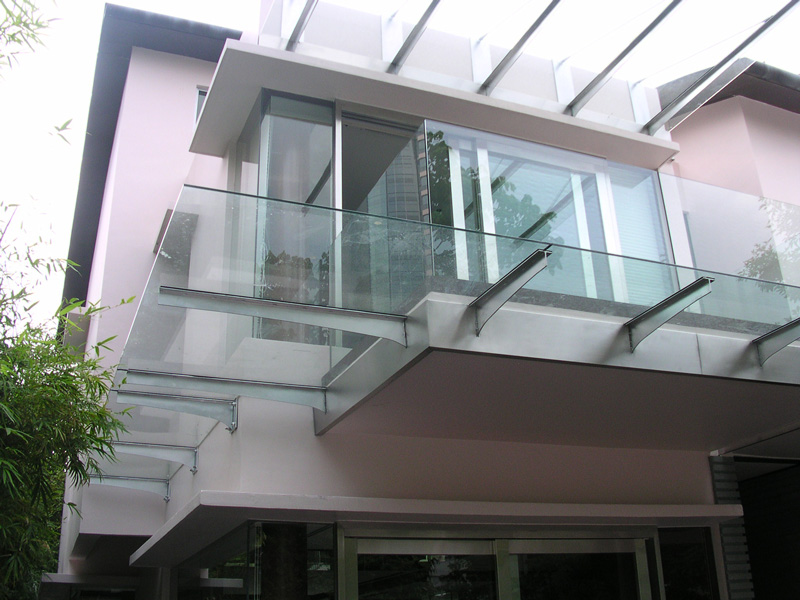
Glass eliminates these weaknesses by virtue of its material composition alone. It does not absorb moisture, cannot host mould growth, and does not fade under UV exposure. The shelter it provides is permanent rather than periodically replaced, making it a fundamentally more stable long-term investment for any fixed outdoor space.
Glass vs Polycarbonate Awnings
Polycarbonate is glass's closest competitor in the Singapore awning market — lighter, cheaper, and easier to install, making it popular for budget-conscious builds. Twin-wall polycarbonate also offers reasonable thermal insulation, reducing heat buildup beneath the canopy compared to single-skin alternatives.
Its critical weakness is optical degradation over time. Polycarbonate sheets exposed to continuous tropical sun gradually yellow and become brittle, compromising both appearance and structural integrity. Glass does not yellow, warp, or degrade optically regardless of sun exposure. It also carries a significantly higher load rating and a more premium visual finish — polycarbonate has an unmistakably plastic appearance that becomes more pronounced as it ages. For homeowners investing in a landed property or commercial shopfront where aesthetics matter over a ten-year horizon, glass consistently outperforms polycarbonate.
Glass vs Metal Sheet Awnings
Zinc, aluminium, and steel sheet awnings are built for pure weather protection. They are extremely durable, highly wind-resistant, and require very little maintenance beyond occasional inspection of fixings and sealant points. In utilitarian rear-of-house applications and industrial settings they remain the practical standard.
Their fundamental limitation is complete opacity. A metal sheet awning blocks all natural light, making the space beneath noticeably darker and creating a visual heaviness that can make compact Singapore homes feel smaller and more enclosed. Glass retains the full weather protection of a metal sheet while allowing diffused natural light through, preserving the openness of the space beneath. For any front-facing, living, or customer-facing area, glass delivers a spatial quality that metal sheet cannot match.
Glass vs Louvre Awnings
Louvre awnings — adjustable slatted aluminium systems — represent the most flexible awning solution available. Individual blades rotate to control sunlight, ventilation, and rain protection simultaneously, with motorised versions offering full adjustment at the touch of a button. They are increasingly popular in Singapore's higher-end residential and hospitality sectors for alfresco areas requiring dynamic weather control.
The trade-off is cost and mechanical complexity. Motorised louvre systems sit at the premium end of the awning market, and their moving components — motors, hinges, and blade seals — require regular servicing to perform reliably in Singapore's humid conditions. Glass awnings have no moving parts, making them essentially maintenance-free by comparison. Louvres justify their premium only where active, real-time control over light and ventilation is genuinely necessary. For permanent shelter with no operational demands, glass offers a cleaner, simpler, and more cost-accessible solution.
Summary

For most permanent residential and commercial installations in Singapore, glass strikes the best balance of longevity, aesthetics, natural light transmission, and long-term value — outperforming fabric and polycarbonate on material grounds, and offering a far simpler ownership experience than a motorised louvre system.