The short answer is yes—but with a massive caveat.
A standard, off-the-shelf retractable roof designed for light European showers will fail miserably under a Singaporean monsoon. However, an architecturally engineered, tropical-spec system can handle a biblical November downpour without breaking a sweat.
Whether a retractable roof keeps your patio dry or turns it into an expensive indoor swimming pool comes down to precision engineering. Here is how a system survives Singapore's monsoon seasons.
The Blueprint for Monsoon Resilience
1. High-Capacity "Deep-V" Internal Gutters
During a monsoon, the sheer volume of water can instantly overwhelm standard drainage.
- The Failure Point: Cheap systems use shallow perimeter channels. When water accumulation outpaces the drainage rate, it spills backward over the tracks and into your living space.
- The Solution: Tropical-spec bioclimatic louvres or sliding glass roofs feature extra-deep, internal "Deep-V" gutter networks. When the roof is closed, the interlocking panels channel water into a heavy-duty perimeter frame. The water is then driven entirely inside the structural hollow posts, bypassing your patio completely.
2. EPDM Rubber Gaskets (The Watertight Seal)
Metal-on-metal contact will always leak. High-performing systems use EPDM (Ethylene Propylene Diene Monomer) gaskets running along the entire length of every single louvre blade or panel joint. EPDM is chosen because it doesn't degrade, crack, or melt under Singapore’s punishing UV index, ensuring the compression seal remains completely watertight when the louvres lock down.
3. Structural Pitch and Slope
A retractable roof should never be perfectly flat. To handle heavy rains, engineers design the system with a mandatory minimum pitch (usually between $5^\circ$ to $8^\circ$ depending on the span). This slope uses gravity to force water into the primary gutters at high velocity, preventing "ponding"—the pooling of water on top of the roof that causes structural sagging or seal failure over time.
The Real Enemy: Lateral Rain and Wind
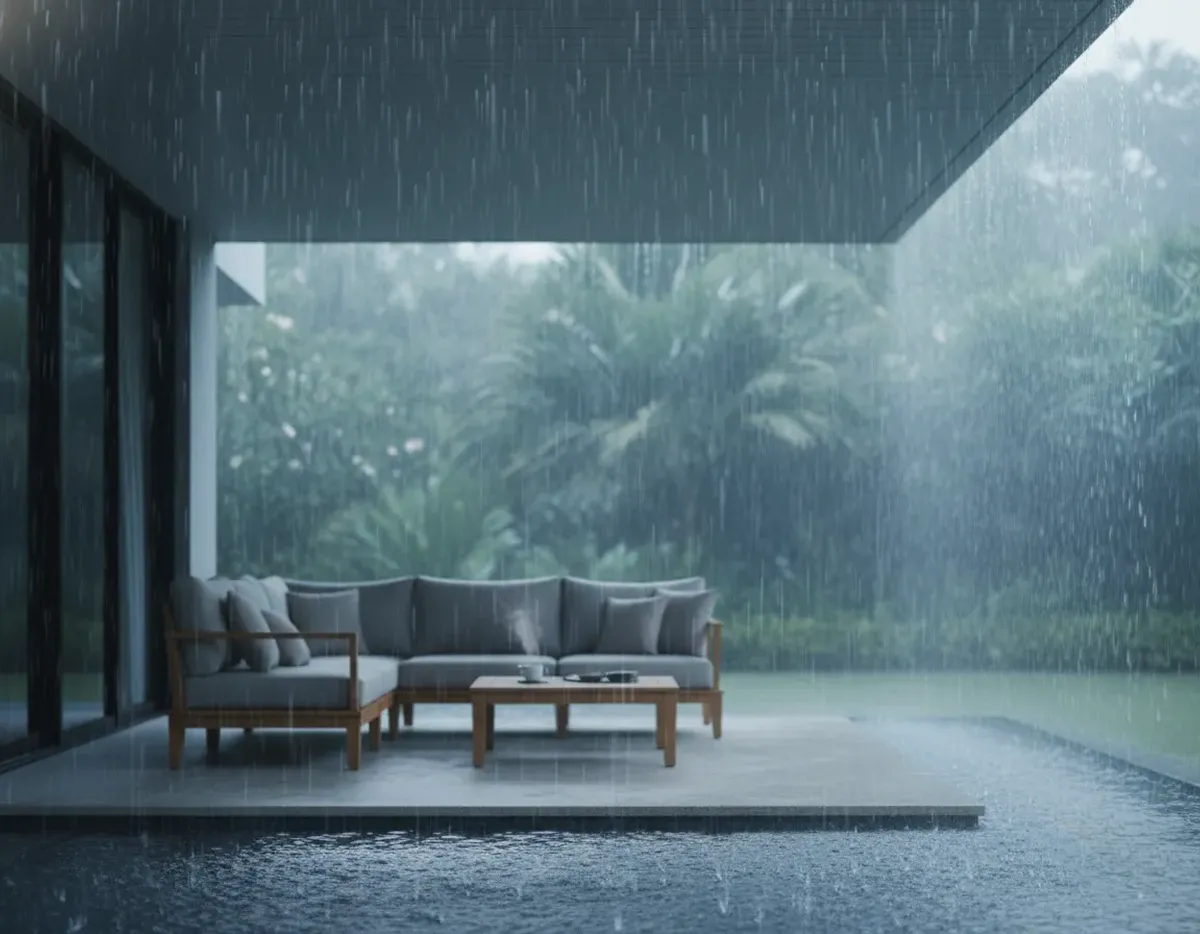
In Singapore, monsoons rarely fall straight down. Sumatra squalls bring violent gusts that drive rain horizontally. Even if your roof is 100% watertight, wind will blow rain right under it from the sides.
The Complete Envelope Solution: To genuinely monsoon-proof a patio, a retractable roof must be paired with motorized vertical side screens.
To handle intense wind pressures without failing, look for side screens engineered with:
- A Heavy-Duty Zip-Guide Track: This locks the fabric securely into the side rails along its entire length. This heavy tension keeps driving rain out while preventing fabric fraying, track jamming, and wind rattling during sudden storms.
- High-Stability Mesh: Utilizing premium dimensional fabrics like Phifer Sheerweave allows the system to reject heavy sheets of water and cut down severe wind loads, while still preserving your external view.
Automation vs. Human Error
The weakest link in any weather-protection system is human reaction time. A monsoon can roll in over Paya Lebar or Bukit Timah in under two minutes. If you are away from home or stuck in a meeting, a manual system is useless.
True monsoon handling relies on an automated control loop:
[Capacitive Rain Sensor] ──> Detects first 2 drops ──> [Smart Hub Controller] ──> [IP65 Motor Engaged] ──> Full Wat
The Verdict: If you invest in marine-grade materials (like 6063-T5 aluminum and Grade 316 stainless steel), prioritize deep internal drainage, and shield the sides against horizontal rain, a retractable roof won't just handle Singapore's monsoons—it will master them.
Are you looking to install a system for a residential landed patio with open sides, or is this for a commercial commercial space like an F&B storefront?