Not sure between 3 mm and 4 mm ACP? Clear guide on stiffness, spans, noise, wind, finishes and cost—so Singapore homeowners can choose confidently.
Choosing Aluminium Composite Panel (ACP) thickness affects how your roof feels, sounds, and lasts. The two common options—3 mm and 4 mm—look similar from the street, but behave differently once installed. Here’s a plain-English guide so you can match thickness to your car porch, balcony, walkway, or shopfront without over- or under-specifying.
What changes when you go from 3 mm to 4 mm?
Stiffness and deflection
4 mm panels are noticeably stiffer, so they flex less between supports. Less flex means a flatter look and fewer vibrations during storms.
Rain noise
Because 4 mm vibrates less, it damps rain noise better than 3 mm—especially on wide spans or windy frontages.
Wind resistance & “oil-canning”
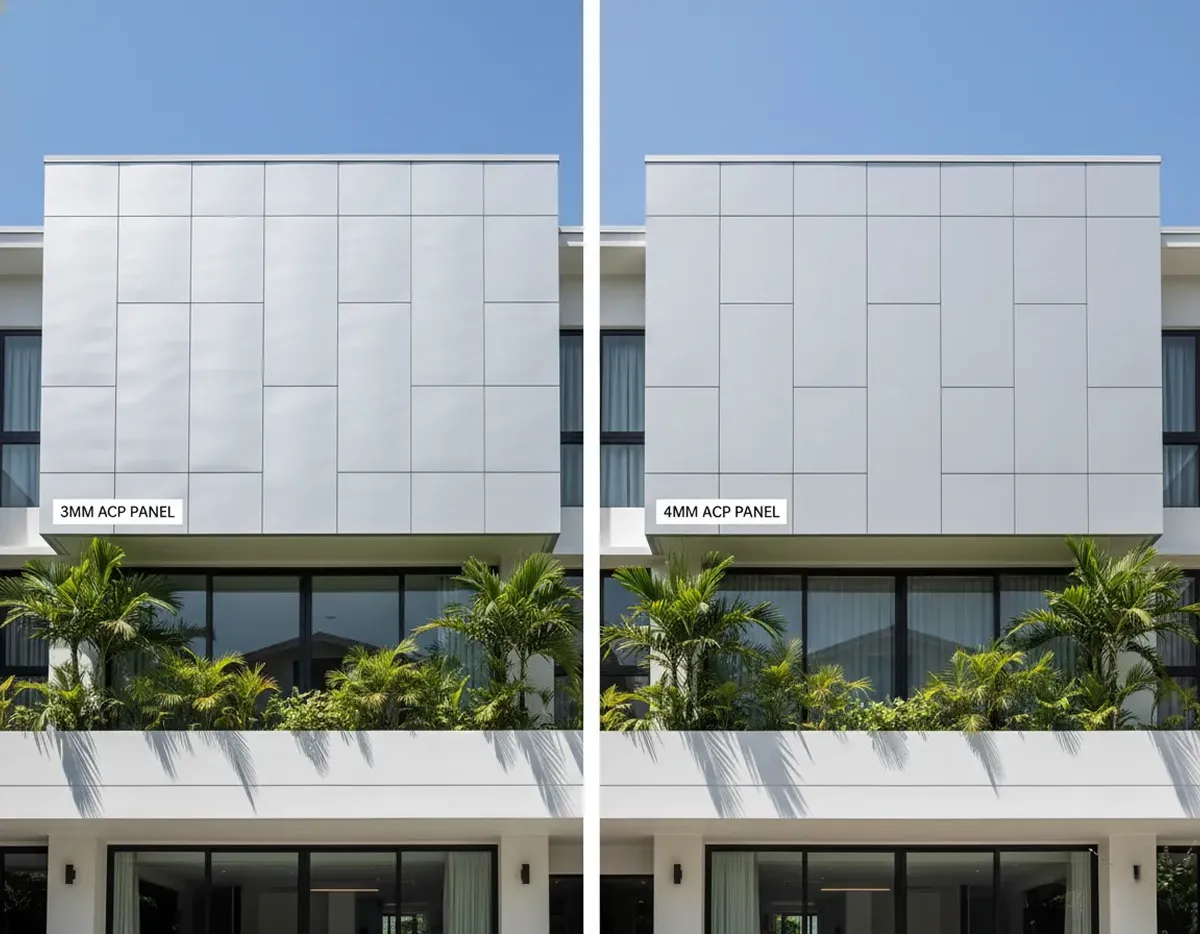
Thicker panels are less prone to ripples (the slight waviness you can see in reflections). That keeps façades looking calm and premium.
Weight & handling
4 mm is slightly heavier, but the difference is small for residential jobs. A good sub-frame handles either thickness.
Cost
Expect a modest price bump moving from 3 mm to 4 mm, mainly due to material and handling. On many car-porch projects, the extra cost is a small fraction of the total.
At a glance: quick comparison
How we decide on-site (the practical way)
1) Span & support layout
- Short spans with more supports → 3 mm is usually fine.
- Wide spans or fewer supports → lean 4 mm for a flatter, quieter result.
Tip: Adding one discreet mid-support can let you keep 3 mm without sacrificing look and sound.
2) Site exposure
- Sheltered (inner courtyard, recess) → 3 mm works well.
- Exposed (corner lots, sea breeze, open streets) → 4 mm handles gusts and reduces drumming.
3) Aesthetic expectations
- Premium, dead-flat façade; dark/metallic finishes (which show ripples more) → choose 4 mm.
- Utility areas (service yard, side walkway) → 3 mm usually meets the brief.
4) Noise sensitivity
- If storm noise bothers you—or you host under the porch—4 mm (optionally with a thin acoustic underlay) is the quiet choice.
5) Budget & value
- If the upgrade cost is modest, prioritise 4 mm where you see and use the space daily (car porch, main balcony). Save 3 mm for secondary zones.
Real-world recommendations by use case
Car porch / driveway (most popular)
- 4 mm for flatter lines and calmer rain sound—worth it where you park and host.
- Consider 3 mm only if spans are short and the site is well sheltered.
Balcony / service yard
- 3 mm is typically sufficient and cost-efficient.
- Upgrade to 4 mm if you want a premium flat look or the balcony faces prevailing wind.
Walkway / linkway
- Mixed: 3 mm for short, frequent supports; 4 mm when supports must be sparser.
Shopfront / F&B
- 4 mm reads cleaner in reflections, pairs well with lighting, and stays quieter in rain during service.
Don’t forget the sub-frame and detailing
Thickness helps, but build quality decides whether a canopy looks and sounds right:
- Sub-frame design: Adequate supports, proper fixings, and sensible spacing prevent panel flutter.
- Slope & drainage: Consistent fall to gutters eliminates ponding (a major noise amplifier).
- Flashing & sealing: Clean wall junctions stop whistling gaps and leaks.
- Edge trims: Straight fascia lines “sell” the flatness your thickness paid for.
Most complaints—ripples, rattles, leaks—trace back to detailing, not the panel itself.
Myths to ignore
- “Thicker is always better.” Not if your frame is under-designed. A well-supported 3 mm can outperform a poorly supported 4 mm.
- “4 mm is heavy and risky.” The weight difference is small; proper fixings and supports matter far more.
- “You can’t get 3 mm to look flat.” You often can—by tightening spans or adding one discreet mid-support.
Cost & value, made simple
Think in zones. Spend where it’s seen and heard every day (porch, balcony). Save where it’s utility (side path). The lifetime experience—flatter look, lower rain noise, fewer tweaks—often justifies 4 mm in front-of-house areas, while 3 mm keeps budgets sensible elsewhere.
Bottom line
- Choose 3 mm for short spans, sheltered spots, and utility areas where budget efficiency matters.
- Choose 4 mm for wider spans, windy sites, front-of-house aesthetics, and quieter rain—the upgrade typically pays back in daily comfort and a calmer façade.
- Either way, insist on a sound sub-frame, clean flashing, proper slope and gutters—that’s where lasting quality comes from.
Still unsure? Let’s size it properly.
Book a Free Site Check. We’ll measure your spans, assess wind exposure, and show side-by-side 3 mm vs 4 mm options with finish samples—plus a clear price range for each. Explore next: [ACP Roofing Singapore], [Polycarbonate Roofing Singapore], [Awning Leak & Flashing Repairs].